

L-R: Brad and Paul White discuss the Aultman Hospital Campus and surrounding neighborhood revitalization project with Aultman Health Foundation’s Liz Edmunds and Kevin Pete.

If you’re like most people, you have probably had a medical emergency at some point in life. Perhaps you woke up in the middle of the night with stomach pain, twisted your ankle doing something around the house and later find your ankle is swollen and can’t walk, or maybe even a child has spiked a fever outside of the pediatrician’s office hours. When a situation like any of these occurs, knowing the difference between Statcare and the emergency department and where you should go could save your life. Today we’re going to talk about treatment, costs and more that are associated with each type of care facility with Mercy Medical Center’s Barbara Frustaci, administrative director ambulatory services.

Pharmacists and hosts, Brad White and Paul White talk with Mercy Medical Center’s Barbara Frustaci about treatment options at Statcare and Emergency Departments.
According to the Sepsis Alliance, Sepsis has been named the most expensive in-patient cost in American hospitals, and in 2014 alone, averaged more than $18,000 per hospital stay. September is Sepsis Awareness Month, and Mercy Medical Center’s Dr. Frank Kaeberlein and Tracey Major, manager medical affairs join the Health Matters program to talk about the dangers and cost associated with this medical condition.

L-R: Pharmacists Brad and Paul White discuss Sepsis Awareness Month with Mercy Medical Center’s Tracey Majors and Dr. Frank Kaeberlein.
If you have low back pain, you are not alone. About 80 percent of adults have experienced low back pain at some point during their lifetimes. It’s the most common cause of job-related disability and a leading contributor to missed work days, according to the National Institute of Neurological Disorders and Stroke. In fact, more than a quarter of adults have reported that they have experienced low back pain during the past three months. Dr. David Gutlove, medical director at Mercy Pain Management Services discusses symptoms, treatment options and more.

Dr. David Gutlove (right) discusses low back pain symptoms, treatment, exercise and more on Health Matters with pharmacists Brad White and Paul White.
Balance problems can make you feel dizzy, often making you feel as if the room is spinning, or you’re unsteady or lightheaded. You might even feel like you're going to fall - whether lying down, sitting or standing.
Many body systems — including your muscles, bones, joints, vision, the balance organ in the inner ear, nerves, heart and blood vessels — must work normally for you to have normal balance. When these systems aren't functioning well, you can experience balance problems.
Listen in to hear Andy Beltz, physical therapist from Aultman Hospital talk about balance issues and dizziness.
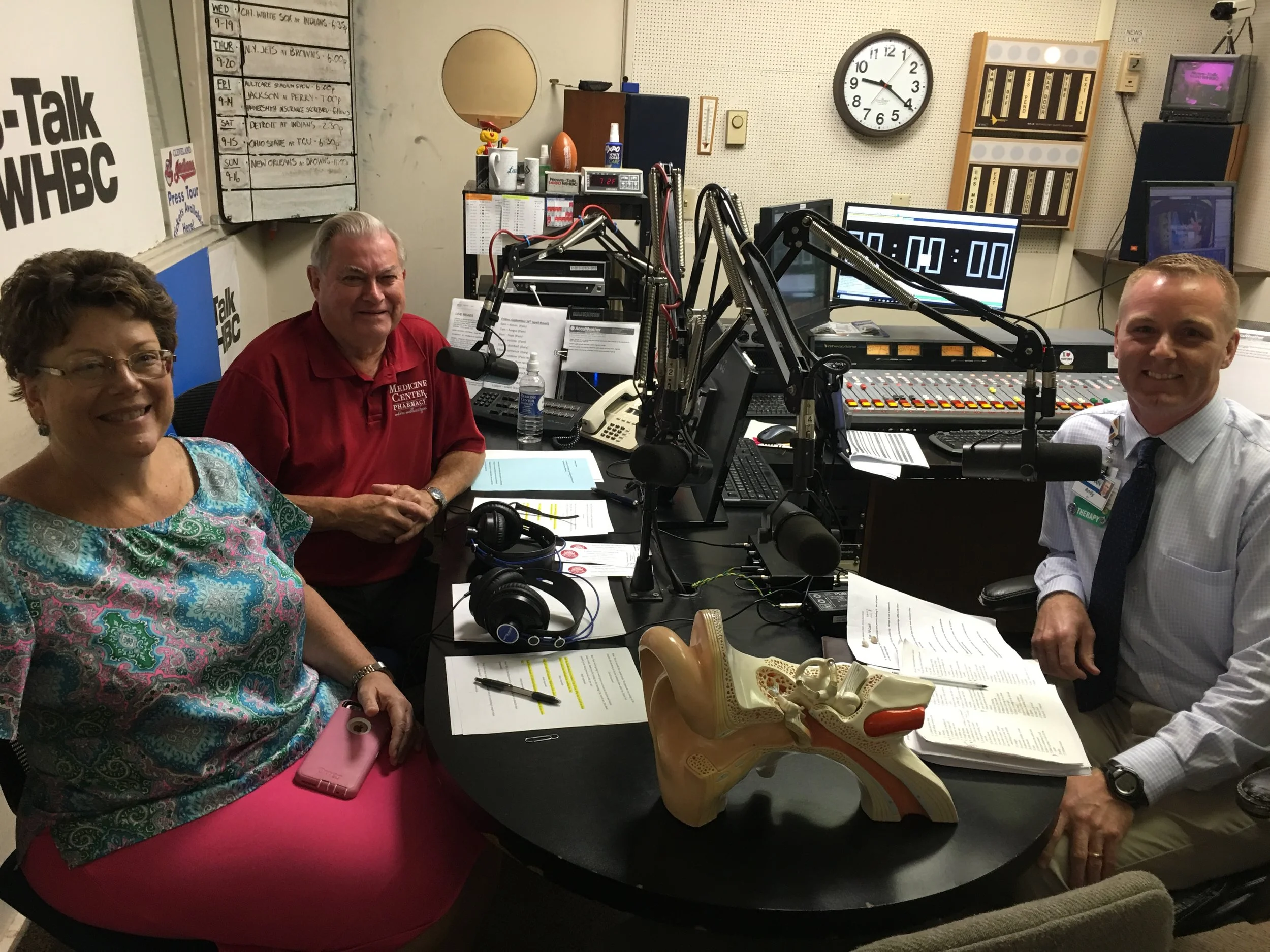
L-R: Medicine Center Pharmacy’s Executive Vice President Nancy Wharmby and Pharmacist Paul White talk with Andy Beltz, physical therapist from Aultman Hospital.
Blindness is one of the most feared disabilities. Although it is believed that half of all blindness can be prevented, the number of people in America who suffer from vision loss continues to increase. The leading causes of vision impairment and blindness in the U.S. are primarily age-related eye diseases. The number of Americans at risk for age-related eye diseases is increasing as the baby boomer generation ages. These conditions, including age-related macular degeneration, cataract, diabetic retinopathy and glaucoma, affect more Americans than ever before. Disturbingly, the number of Americans with age-related eye disease and the vision impairment that results is expected to double within the next three decades.

Hosts Brad White, R. Ph. and Paul White, R. Ph. talk with Dr. Paul Turgeon from Eye Centers of Ohio.

L-R: Health Matters broadcasts live from the MAPS Museum. Paul White, R.Ph. talks with Ted Mathies, Vietnam veteran and medic, and Reed Kimball, Colonel USAR Retired and director of education for the MAPS Museum, with Brad White, R. Ph.
The high school football season kicks off, and along with it comes many types of sports injuries. Especially concerning to athletes, parents and coaches are head injuries and concussions. According to the Centers for Disease Control, an estimated 300,000 head injuries occur among high school athletes each year.
In this segment of Health Matters, we talk about the impact of head injuries and other traumatic sports injuries with sports medicine specialist, Dr. James Goff from Cleveland Clinic Union Hospital, who has served as team doctor for several high schools and universities.

L-R: Pharmacists and hosts, Brad White and Paul White discuss concussions, head injuries and other sports-related injures with Dr. James Goff, sports medicine specialist from Cleveland Clinic Union Hospital.
From routine cavities to sleep apnea and heart disease, your dentist is a key partner in overall health. As Dr. Brian Amison from Amison Dental Group explains, "The mouth is the gateway to the body."
Today's program features Dr. Amison discussing the timeliness of treatment when an injury occurs, mouth guards, implants, dry mouth, the annual Dentistry from the Heart Event and more.

Health Matters hosts and pharmacists, Brad White and Paul White discuss general dentistry with Dr. Brian Amison of Amison Dental Group.

L-R: Pharmacists Brad White and Paul White discuss the SWAP Syringe Exchange Program and Hepatitis A with Canton City Public Health's Amanda Archer, epidemiologist and Diane Thompson, nursing director.
Estate planning can sound intimidating, and many people think they don’t need to do any type of estate planning – perhaps because they have a will, or they may not be wealthy or have multiple assets. However, estate planning is for everyone. In this segment of Health Matters, we talk with Attorney Jim Contini from Krugliak, Wilkins, Griffiths & Doughterty Co., LPA about the importance of planning and hear examples that can help us.

L-R: Hosts and pharmacists, Brad and Paul White talk with Jim Contini, attorney for Krugliak, Wilkins, Griffiths & Doughtery Co., LPA
Summer is here and looking your best is usually top of mind for vacationers, sunbathers and pretty much anyone who wants to show more skin. But, as we all know, putting the pounds on is a lot easier than taking them off. In this segment, we hear about some healthy eating alternatives and get some advice on losing some of those unwanted pounds. We’ll also talk about weight management resources at Mercy Medical Center.

Pharmacists and hosts Brad White and Paul White talk about healthy weight loss with Mercy's Sereen Zawahri-Krasuna.
People with Parkinson's Disease may notice changes or difficulty chewing, eating, speaking or swallowing at any time but tend to increase as the disease progresses. Just as Parkinson's Disease affects movement in other parts of the body, it also affects the muscles in the face, mouth and throat that are used in speaking and swallowing. In this segment of Health Matters we talk about different types of therapy that help people adjust and maintain speaking abilities and understanding with therapists from Aultman Hospital. Also, if you're looking for general resources available in Northeast Ohio, check out the Ohio Parkinson's Foundation.

From left, Brad White and Paul White discuss Parkinson's Disease with Aultman Hospital's Michelle Sommers and Chad Gooding.
Nearly half of all adults in the U.S have high blood pressure, the most common controllable cause of stroke. This is why the American Heart Association/American Stroke Association, with the support of Massillon City Health Department, has launched Check. Change. Control., a free program to help people in our community identify, lower and maintain healthy blood pressure levels.

L-R: Hosts and pharmacists Brad White and Paul White discuss the Check. Change. Control. blood pressure program with Massillon City Health Department Public Health Nurse Audrey Milburn and American Heart Association Community Health Director Tim Lewis.
E-cigs, vapes and juuls are hot topics. Popular among teens, you can find interesting and enticing videos on social media, but they are not necessarily popular among parents. Today we learn more about whether they are safer than cigarettes, talk about the flavored juices used in them and find out more about what the risks and consequences are from the experts at Mercy Medical Center.

Mercy Medical Center respiratory therapists, Mary Duffield (left) and Dustin Shetler (right) discuss e-cigs, vaping and pulmonary effects with Medicine Center Pharmacy's Nancy Wharmby and Paul White.
When it comes to medication, a lot goes on behind the scenes that impacts the final cost of medicine. Gag orders, clawbacks and PBMs, also known as pharmacy benefit managers, play a significant role in soaring medication costs. Antonio Ciaccia, director of government and public affairs for the Ohio Pharmacists Association, explains how this could be changing thanks to the efforts of a Canton politician.

Americans on average do not live as long as people in other high-income countries like France, Britain and Japan. But with modern medicine and health options available in the U. S., life expectancy should be much longer. With simple lifestyle changes, we can extend our lifespan by more than a decade. In this segment of Health Matters you'll hear about practical steps you can take for healthy living and learn a few tips on how to save money at the pharmacy.

Health Matters show hosts Brad and Paul White.
Robotic surgery is a type of minimally invasive surgery, which means that instead of operating on patients through large incisions, mini-size surgical instruments that can fit through a series of quarter-inch incisions are used. Robotic surgery, or robot-assisted surgery, allows doctors to perform many types of complex procedures with more precision, flexibility and control than is possible with conventional techniques. Today we learn what this could mean for people who may have surgery in the future. Join us for a discussion with Dr. Steven Kelly, General Surgeon, Aultman Medical Group General Surgery.

L-R: Health Matters hosts and pharmacists, Brad White and Paul White discuss robotic surgery with Dr. Steven Kelly, general surgeon, Aultman Medical Group General Surgery.
The American Cancer Society estimates that about 20 percent of cancer cases are preventable. A key element to early detection is screenings, which can help doctors find and treat several types of cancer early before symptoms begin. Early detection is vital because when abnormal tissue or cancer is found early, it may be easier to treat as well as prevent the spread of cancer. In this segment of Health Matters, cancer nurse navigators Tara Barker, registered nurse, and Nicole Haines, registered nurse, of Mercy Medical Center talk about various cancer screenings with the experts.

L-R: Brad and Paul White, hosts and pharmacists talk with nurse navigators, Tara Barker, RN, and Nicole Haines, RN, of Mercy Cancer Center.
Atrial fibrillation, commonly known as A-Fib, is a quivering or irregular heartbeat that can lead to blood clots, stroke, heart failure and other heart-related complications. According to the American Heart Association, 2.7 million Americans are living with A-Fib. Treatment options range from medications to non-invasive as well as surgical procedures. Today, Dr. Sardar talks with us about A-Fib and treatment options including a relatively new procedure – the Watchman Device

L-R: Medicine Center Pharmacy Executive VP Nancy Wharmby and Pharmacist and Host Paul White talk with Dr. Rizwan Sardar.