Posts in Stroke Awareness
Stroke Awareness Month: Why Every Second Counts After a Stroke

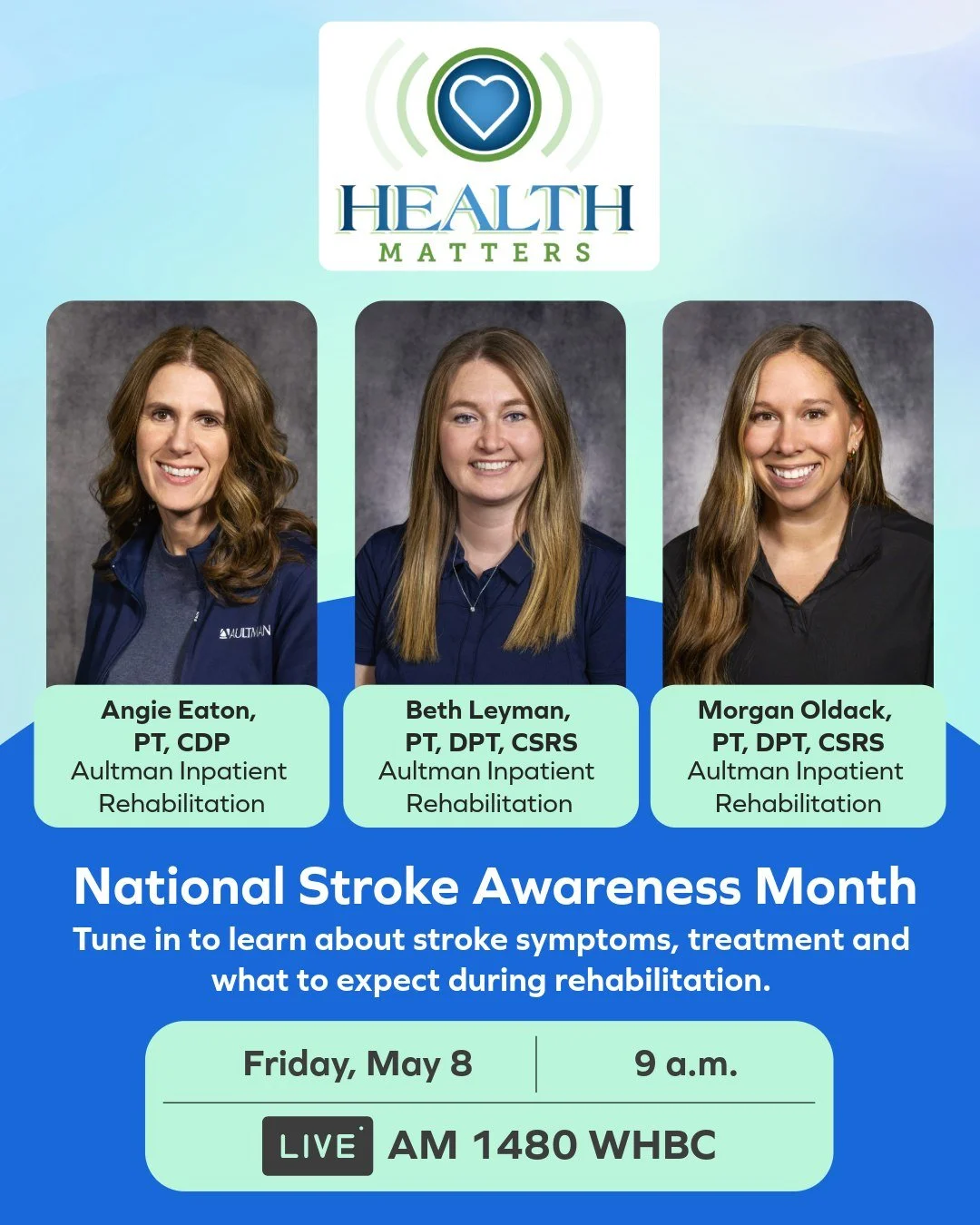
May is Stroke Awareness Month, and on a recent episode of the Health Matters with the Medicine Center Pharmacy podcast, pharmacists Paul White and Brad White welcomed stroke rehabilitation specialists Angie Eaton, Beth Layman, and Morgan Odeck from Aultman Health System to discuss stroke prevention, warning signs, treatment, and recovery.

Stroke remains one of the leading causes of death and long-term disability in the United States. The encouraging news? Fast action, early treatment, and rehabilitation can dramatically improve outcomes.

What Is a Stroke?

A stroke occurs when blood flow to part of the brain is interrupted, depriving brain tissue of oxygen and nutrients. According to the rehabilitation team, there are two primary types of stroke:

  • Ischemic Stroke — caused by a blockage or clot restricting blood flow to the brain.

  • Hemorrhagic Stroke — caused by bleeding from a ruptured blood vessel in or around the brain.

Because brain cells begin to die quickly during a stroke, time is critical.

Remember “BE FAST”

The rehabilitation specialists emphasized the importance of recognizing stroke symptoms early using the acronym BE FAST:

  • B – Balance: Sudden dizziness or coordination problems

  • E – Eyes: Vision changes or blurred vision

  • F – Face: Facial drooping or uneven smile

  • A – Arms: Weakness or numbness in an arm or leg

  • S – Speech: Slurred speech or difficulty speaking

  • T – Time: Call 911 immediately

One of the biggest mistakes patients make is trying to “sleep off” symptoms instead of seeking emergency care right away.

Why Early Treatment Matters

For some ischemic strokes, hospitals may administer a clot-busting medication called tPA, which is most effective when given within the first few hours after symptoms begin. Quick treatment can reduce brain damage and improve recovery potential.

The guests stressed that stroke is always a medical emergency and that every minute matters.

The Power of Stroke Rehabilitation

Rehabilitation often begins within 24–48 hours after a patient is medically stabilized. The goal is to help patients regain strength, movement, speech, balance, and independence as early as possible.

At inpatient rehabilitation facilities like Aultman Woodlawn, patients may participate in:

  • Physical therapy

  • Occupational therapy

  • Speech therapy

  • 24-hour nursing support

  • Physician oversight several times per week

Patients commonly receive at least three hours of therapy daily, five days per week.

Understanding Neuroplasticity

One of the most fascinating concepts discussed during the program was neuroplasticity — the brain’s ability to adapt and form new neural pathways after injury.

The therapists compared it to building a new highway around a traffic jam. Through repetition, movement, therapy, mental imagery, and practice, the brain can continue learning and recovering long after a stroke occurs.

This means recovery can continue for months — and even years — following a stroke.

Recovery Looks Different for Everyone

Stroke recovery varies depending on:

  • The size and location of the stroke

  • How quickly treatment was received

  • The patient’s overall health

  • Motivation and participation in therapy

  • Support systems at home

Some patients experience mobility challenges, speech difficulties, memory problems, or fatigue. Others may struggle more with communication or processing information. Specialized therapy programs and assistive technologies can help patients regain independence and improve quality of life.

Supporting Patients Beyond the Hospital

At Medicine Center Pharmacy, we believe education and community awareness are essential parts of improving health outcomes. Stroke awareness begins with recognizing symptoms early and encouraging loved ones to seek immediate medical attention.

If you missed this episode of Health Matters with the Medicine Center Pharmacy, you can listen on your favorite podcast platform or visit our YouTube channel for the full discussion.

Early recognition saves lives — and recovery is possible with the right care, support, and rehabilitation.

Thanks for listening today! We’d like to remind our listeners, if you suspect you have a medical issue, please contact your healthcare provider. Thanks to our sponsor Aultman Health System. As always, we thank our listeners for joining us on Health Matters with the Medicine Center Pharmacy. Have a healthy week and we’ll see you again next Friday right here on News Talk 1480 WHBC.

Understanding Stroke and Saving Lives: Health Matters Podcast Shines a Light During National Stroke Awareness Month

May is National Stroke Awareness Month—a time dedicated to educating the public about stroke prevention, recognizing the signs and symptoms, and supporting survivors and caregivers. On this special episode of the Health Matters Podcast, we’re honored to welcome two remarkable guests from the Aultman Health System Stroke Center in Canton, Ohio: Andra Lloyd, BSN, RN, SCRN and Ashley McConnell, BSN, RN.

As certified stroke nurses, Andra and Ashley bring deep expertise and firsthand insight into what it takes to respond to stroke emergencies, support recovery, and spread awareness throughout our community. During the podcast, they share life-saving knowledge about:

The warning signs of a stroke and why every second counts

  • How to recognize the acronym B.E.F.A.S.T. (Balance, Eyes, Face, Arms, Speech, Time) to act quickly

  • The critical role of early intervention and how local hospitals like Aultman are prepared to provide rapid, expert care

  • How lifestyle changes—from managing blood pressure to staying active—can reduce your risk of stroke

This conversation isn’t just medical—it’s motivational. Whether you or a loved one is at risk, or you’re simply seeking to be more informed, this episode arms you with knowledge that could save a life.


We are grateful to Andra and Ashley for their passion, professionalism, and commitment to stroke care. Their dedication to patient outcomes and public education is a powerful reminder of the difference healthcare providers make every day.

Tune in to this special Health Matters episode and join us in spreading stroke awareness all month long—and beyond.

Listen now at medshoprx.com/podcast or wherever you get your podcasts.


Listen to the episode on Apple Podcasts, Spotify, Castro, Stitcher, Amazon Music, or on your favorite podcast platform.


What the replay of the YouTube Live Broadcast here:

Thanks for listening today! We’d like to remind our listeners, if you suspect you have a medical issue, please contact your healthcare provider. Thanks to our sponsor Aultman Health System. As always, we thank our listeners for joining us on Health Matters with the Medicine Center Pharmacy. Have a healthy week and we’ll see you again next Friday right here on News Talk 1480 WHBC.

Aphasia: Speech Impairment After Stroke or Brain Injury

Health Matters is a weekly radio show sponsored by the Medicine Center Pharmacy on WHBC 1480 AM in Canton, Ohio. This episode pharmacists Brad White and Paul White discuss Aphasia with Debbie Adams-Shumaker, Manager and Licensed Speech Pathologist, Mercy Therapy Services.

Learn more about Mercy Stroke Support Group

Contact Mercy Therapy Services for more information about Speech Therapy and the scope of services they offer in the community.

Thanks for listening today! We’d like to remind our listeners, if you suspect you have a medical issue, please contact your healthcare provider. Thanks to our sponsors Cleveland Clinic Mercy Hospital, Studio Arts & Glass. As always, we thank our listeners for joining us on Health Matters with the Medicine Center Pharmacy. Have a healthy week and we’ll see you again next Friday right here on News Talk 1480 WHBC.

National Stroke Awareness Month


Health Matters is a weekly radio show sponsored by the Medicine Center Pharmacy on WHBC 1480 AM in Canton, Ohio. This episode pharmacists Brad White and Paul White discuss Stroke Awareness Month with Maria Griffin, APRN-CNP, coordinator for Cleveland Clinic Mercy Hospital’s Stroke Center.

Topics will include risk factors, warning signs, preventive measures, treatment options and statistics related to stroke

The Facts:

  • Stroke can happen to anyone at any age.

  • 80% of all strokes are preventable.

  • Stroke is the fifth leading cause of death in the U.S. and a leading cause of severe disability.

  • On average, one person dies from stroke every 4 minutes.

  • More than 795,000 people have a stroke each year in the U.S.

  • Stroke kills almost 130,000 of the 800,000 Americans who die of cardiovascular disease each year—that’s 1 out of every 19 deaths from all causes.

Thanks for listening today! We’d like to remind our listeners, if you suspect you have a medical issue, please contact your healthcare provider. Thanks to our sponsors Cleveland Clinic Mercy Hospital, Studio Arts & Glass. As always, we thank our listeners for joining us on Health Matters with the Medicine Center Pharmacy. Have a healthy week and we’ll see you again next Friday right here on News Talk 1480 WHBC.

Anyone can have a stroke, and everyone should be prepared.

Anyone can have a stroke, and everyone should be prepared.